





Nepal Floods: When Water Becomes a Force of Destruction
Floods remind us of the immense power of water. Water sustains every form of life, but when intense rainfall moves through a landscape faster than the land can absorb, slow, or store it, the same force can become destructive.
Rivers can swell rapidly, drainage systems can become overwhelmed, slopes can become unstable, and communities can face severe damage. In mountainous regions such as Nepal, the relationship between rainfall, rivers, forests, soil, and human settlements becomes especially important because what happens higher in the landscape can affect people and ecosystems far downstream.
Floods Are More Than Too Much Water
It is easy to describe a flood simply as a problem of “too much water.” But the deeper question is how a landscape receives, holds, slows, and releases that water.
Rain does not fall onto an empty surface. It interacts with vegetation, soil, roots, streams, wetlands, ponds, and slopes.
A healthy landscape can absorb and retain significant amounts of rainfall. Vegetation protects the soil surface, roots create pathways through which water can infiltrate, and organic matter can improve the soil’s capacity to hold moisture.
When these natural processes are functioning together, the landscape has a greater ability to manage rainfall.
A Healthy Landscape Acts Like a Sponge
A healthy landscape can be compared to a sponge.
Vegetation slows rainfall before it reaches the ground. Plant roots create channels that allow water to move into the soil. Organic matter helps the soil retain moisture. Wetlands and natural water bodies can provide additional space for water during periods of heavy rainfall.
Together, these elements help slow the movement of water across the landscape.
The goal is not to stop water. It is to give water more opportunities to enter the soil, remain in the landscape, and move gradually through natural systems.
When Landscapes Lose Their Capacity
Landscape degradation can change how rainfall behaves.
When forests are degraded, soil becomes compacted, wetlands disappear, or natural drainage patterns are altered, the land may become less capable of absorbing intense rainfall.
More water can then move rapidly across the surface, carrying soil with it and increasing erosion and runoff.
This does not mean that every flood can be prevented. Extreme rainfall can overwhelm even healthy ecosystems. However, restoring the ability of landscapes to absorb, retain, and slow water can help reduce vulnerability and strengthen resilience.
What Can Agriculture Learn From Floods?
Floods offer an important lesson for agriculture.
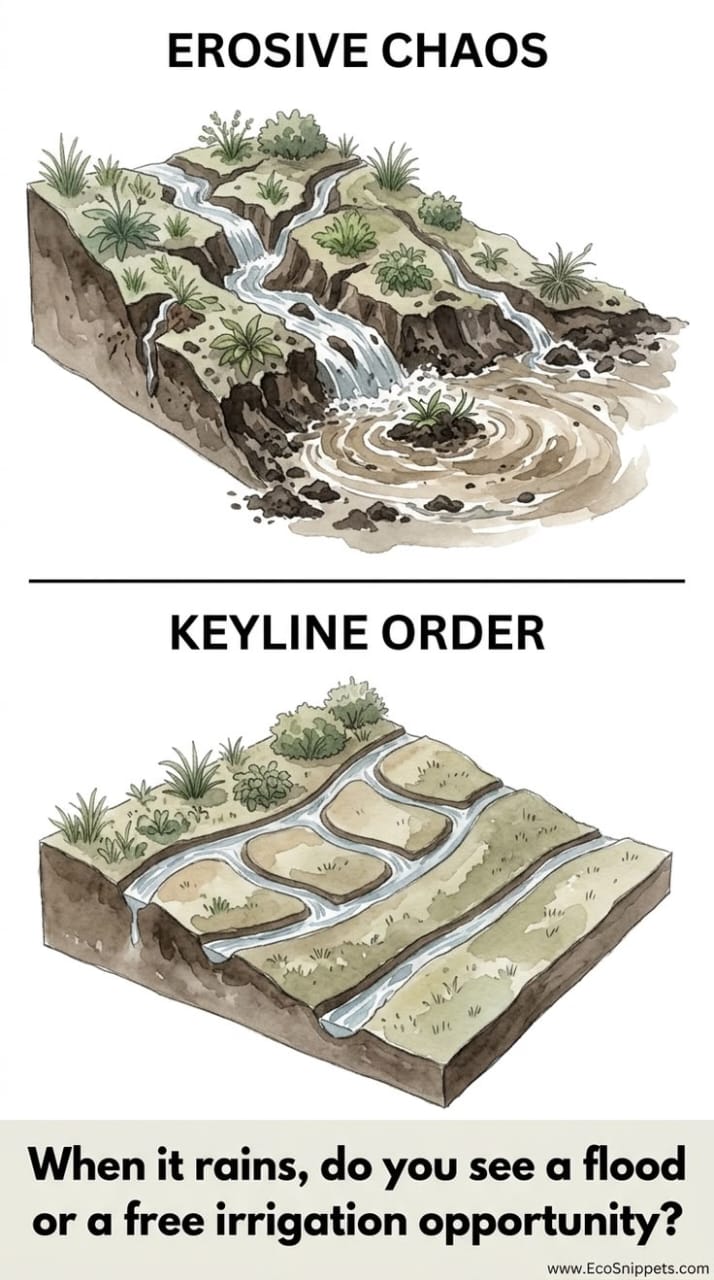
Instead of viewing water only as something that needs to be removed from a farm as quickly as possible, a regenerative approach asks how water can be managed as part of the landscape.
Slow it.
Spread it.
Sink it.
Store it.
These principles encourage farmers to work with the natural movement of water rather than against it.
Designing Farms to Work With Water
Trees, contour-based earthworks, ponds, wetlands, groundcover, mulch, and healthy soils can all contribute to a larger water-management system.
Trees and groundcover help protect the soil from the direct impact of rainfall. Mulch can protect the soil surface and support moisture retention. Contour-based approaches can slow the movement of water across slopes, while ponds and wetlands can provide places where water can collect and remain within the landscape.
When these elements are considered together, water management becomes part of the design of the entire farm.
Rain Is an Opportunity
The lesson is especially important for farmers.
Rain is not only something that falls on a farm. It is an opportunity to recharge the landscape.
Every drop that can safely enter the soil, replenish groundwater, support vegetation, or remain available for future use contributes to the resilience of the farm.
The challenge is to understand where water comes from, where it naturally wants to go, and how the landscape can help slow and retain it.
Learning From the Land at Amrut Krushi
At Amrut Krushi Natueco Science Research Centre, water is viewed as an integral part of landscape design.
By observing how water naturally moves across the land, it becomes possible to understand where erosion may occur, where water can be retained, and where the landscape can be designed to support greater infiltration and moisture storage.
This approach begins with observation rather than simply reacting to water after it becomes a problem.
Understanding the movement of water can help create farms that retain more moisture while reducing unnecessary erosion and runoff.
Water Must Be Understood and Respected
Floods remind us that water is never merely a resource to be used.
It is a powerful force of nature that shapes landscapes, moves soil, supports ecosystems, and sustains life. Our responsibility is not to control every movement of water, but to understand its natural behavior and design landscapes that can work with it.
The tragedy of floods should therefore encourage us to look beyond the immediate event and examine the condition of the landscape itself.
After every flood, one question deserves particular attention:
“What did the landscape do with the water?”
The answer can tell us a great deal about the health, resilience, and regenerative capacity of the land.